Gate-Level Cybernetic Classifier
A binary classifier that corrects its own decision boundary from feedback, in pure deterministic hardware.
This project asks how far adaptive behavior can go without software: can a purely deterministic gate-level circuit alter its own decision boundary in response to feedback, with no processor or instruction set involved? It evolves in three stages, from strict Boolean pattern matching, through pop-count similarity against a variable threshold, to a feedback-driven system that corrects itself.
Versions built
- Detector v0.0 to v0.2, strict Boolean matching. No learning; the decision boundary is fixed by structural wiring. v0.2 adds a 2-point-of-view analysis distinguishing sub-pattern, super-pattern, anti-pattern, and equivalence.
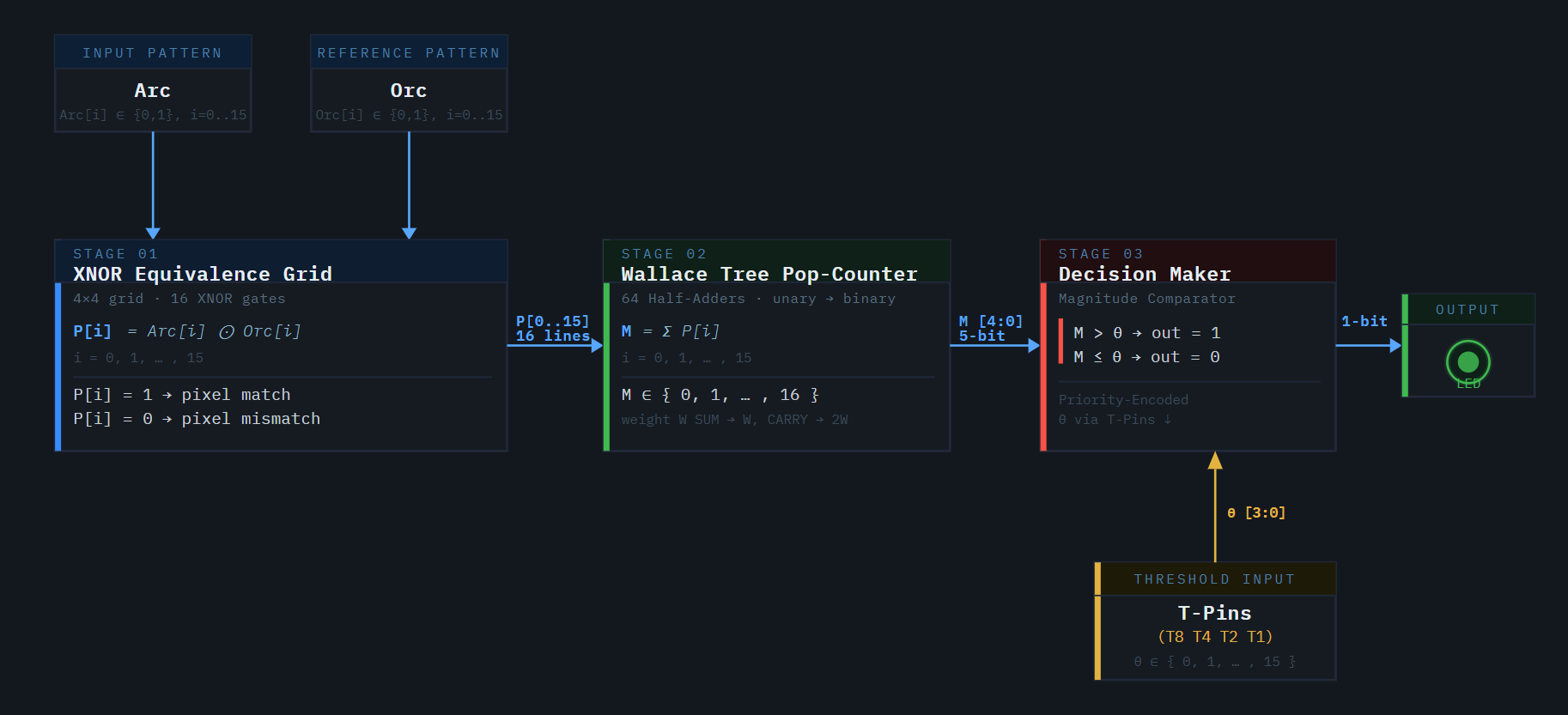
- Detector v1.0, pop-count-based recognition against a variable threshold, replacing exact equivalence with a tolerance the designer can adjust.
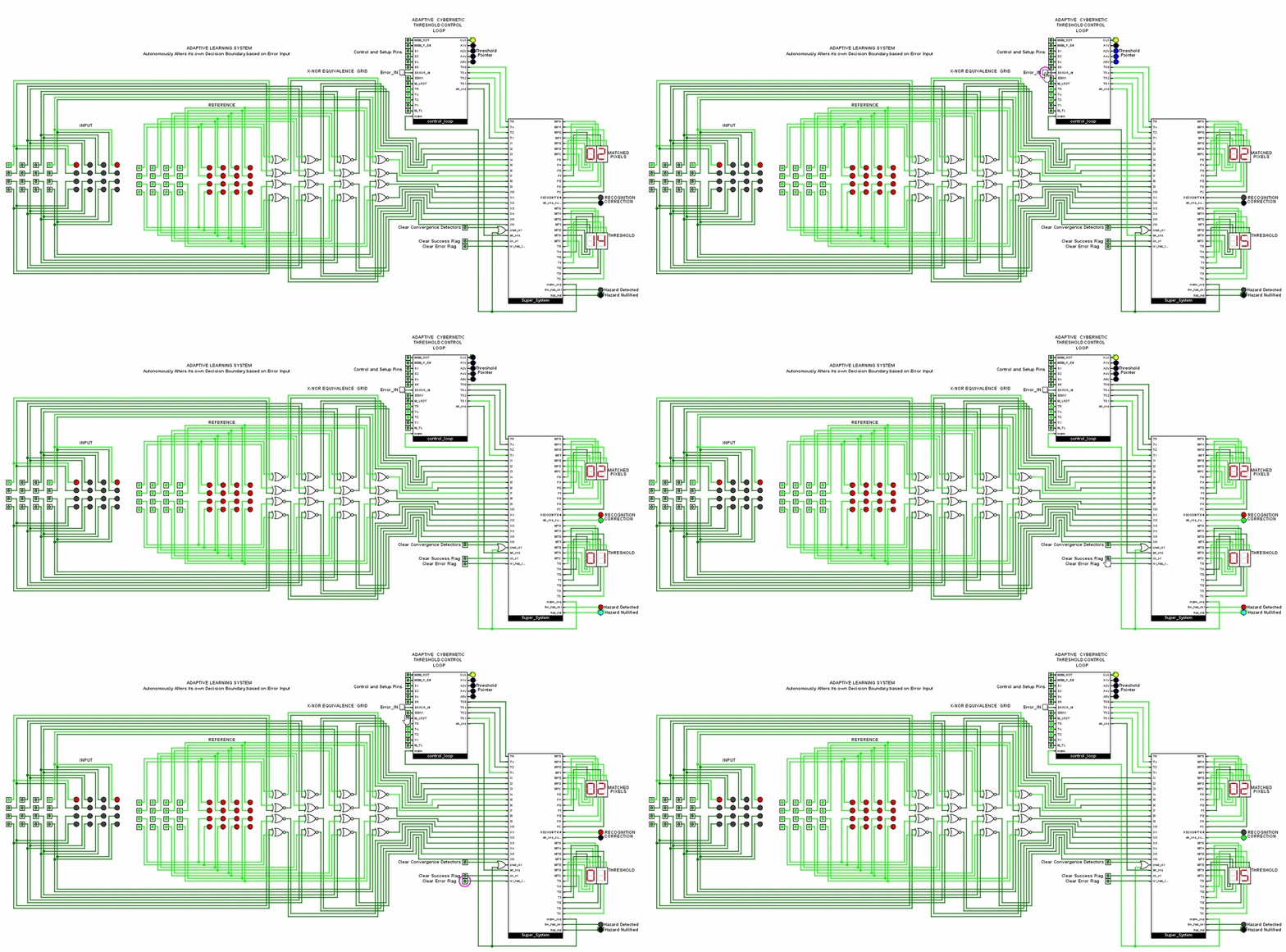
- Detector v1.1, cybernetic feedback-driven adaptive learning. The system now adjusts its own threshold in response to an error signal, with no manual intervention.
Two correction algorithms
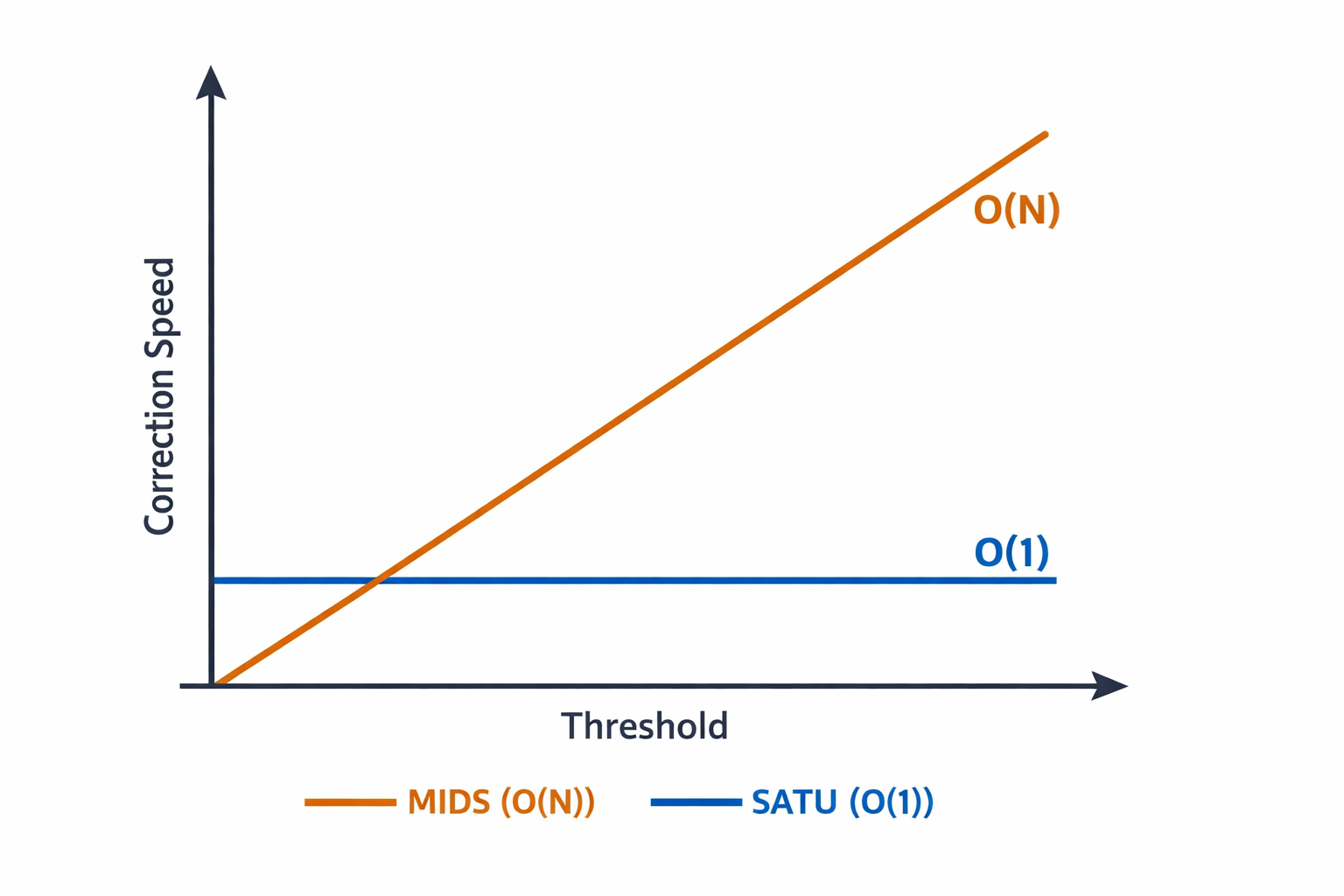
Version 1.1 implements two distinct approaches to threshold correction, each with a formal convergence proof for thresholds M in the range 1 to 15: Max-Initialized Decremental Search (MIDS), which starts at the maximum threshold and searches downward, and State-Aware Threshold Update (SATU), which computes the correct threshold directly from the current and desired output.
| Property | MIDS | SATU |
|---|---|---|
| Correction speed | O(N) | O(1) |
| Strategy | Iterative threshold traversal | Direct threshold computation |
| Threshold memory | Required | Not required |
| Synchronization | Multiple requirements | Single synchronizer |
| Hardware complexity | Higher | Lower |