FIFO Architectures
Three FIFOs in Chisel, showing how the architecture changes with clocking, clock-domain crossing, and control flow.
A FIFO looks like one component, but its right design depends on what the system around it demands. This project implements three parameterized FIFOs in Chisel, a Scala-embedded hardware construction language: a synchronous FIFO in a single clock domain, an asynchronous FIFO that crosses between independent read and write clocks, and an elastic FIFO with valid/ready flow control for backpressure. Each is elaborated into SystemVerilog and taken through simulation, verification, synthesis, and timing analysis.
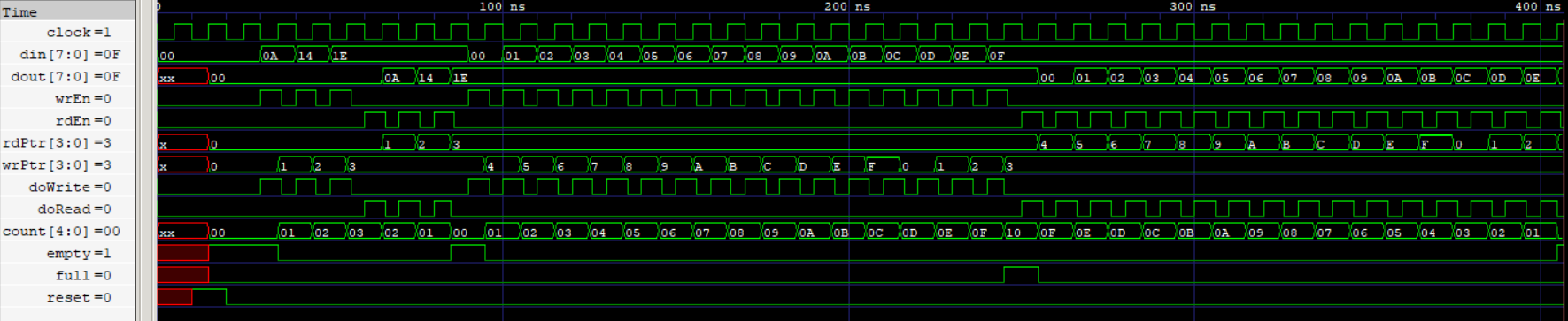
Architectures built
- Synchronous FIFO, a single clock domain with circular memory addressing, read/write pointers, occupancy tracking, and concurrent read/write support.
- Asynchronous FIFO, independent read and write clock domains, with cross-domain pointer synchronization so full and empty can be detected safely across the boundary.
- Elastic FIFO, a single clock domain with a valid/ready interface, where full and empty are expressed through handshake signaling and backpressure propagates to the producer.
Post-synthesis characterization, Sky130HD
All three are characterized at the same configuration, 16 × 8-bit (128 bits of storage).
| Architecture | Area | Crit. path | Fmax | Power |
|---|---|---|---|---|
| Synchronous FIFO | 5,915.7 µm² | 3.03 ns | ~330 MHz | 865 µW |
| Asynchronous FIFO | 6,730.2 µm² | 2.94 ns | ~340 MHz | 2,130 µW |
| Elastic FIFO | 5,620.4 µm² | 2.94 ns | ~340 MHz | 793 µW |
Verification
Each architecture is verified at three levels: Chisel-native directed and randomized tests, an independent SystemVerilog testbench on the generated RTL, and gate-level simulation of the post-synthesis netlist using Sky130HD functional cell models.