Harvard Processor
A parameterized, multi-cycle Harvard-architecture processor built from 12 coordinated RTL modules.
The processor follows a Harvard architecture: separate program and data memories, a custom instruction set, a hardwired control unit, and a multiplexer-based internal data bus. It's demonstrated at 8 bits but parameterized to any data width at instantiation. Twelve independent modules, the ALU, registers, program counter, ROM, RAM, memory address register, flags register, instruction register, T-state counter, and control unit, are coordinated through T-state sequencing into one multi-cycle datapath.
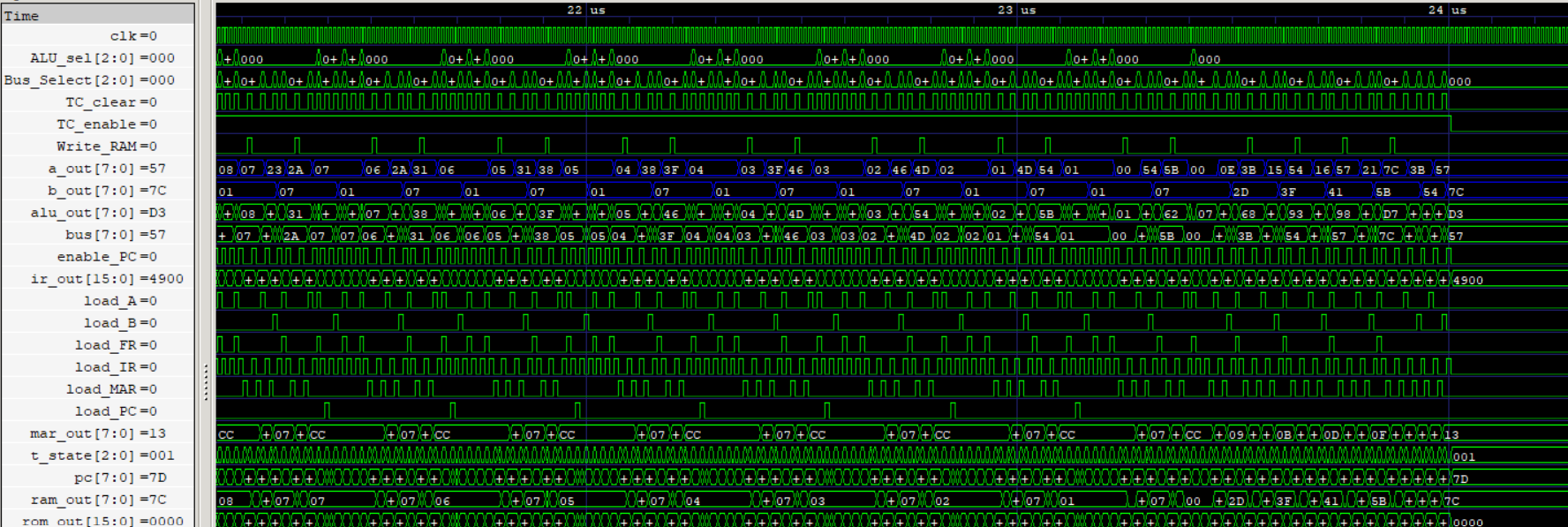
Verification
The RTL is verified with both classical Verilog testbenches and self-checking cocotb testbenches, across three strategies: directed tests for reset, load, hold, increment, and control priority; randomized tests validated in Python against a software reference model; and, for combinational modules like the ALU, exhaustive tests covering every possible input combination.
Physical characterization
Post-synthesis results below use the Sky130HD standard-cell library, with static timing analysis constrained to a 10 ns clock, 1 ns input delay, and 1 ns output delay.
| Module | Area | Critical path | Fmax | Power |
|---|---|---|---|---|
| General Purpose Registers | 320.3 µm² | 1.41 ns | ~709 MHz | 39.8 µW |
| Arithmetic and Logic Unit | 877.1 µm² | 3.21 ns | ~311 MHz | 349 µW |
| Control Unit | 359.1 µm² | 2.29 ns | ~437 MHz | 41.4 µW |
| ROM (256×8) | 2,277.2 µm² | 2.85 ns | ~351 MHz | 888 µW |
| RAM (256×8) | 75,862.8 µm² | 5.18 ns | ~208 MHz | 9.88 mW |
| Full Computer | 80,347.1 µm² | 25.55 ns | ~39 MHz | 8.67 mW |
Amdahl's Law study: removing the MAR
An architectural study examined what happens when the Memory Address Register is eliminated from the datapath, letting memory be addressed more directly. Before the change, 84% of the ISA executed in 2 T-states; after it, 100% did, giving every instruction a uniform 2-cycle execution time. Amdahl's Law was used to validate the change.
| Benchmark | Maximum speedup | Clock cycles saved |
|---|---|---|
| Maximum of two numbers | 1.250× | 3 |
| Unsigned multiplication | 1.269× | 1,786 |
| 2×2 matrix multiplication | 1.231× | 12,256 |