High-Performance Adder Architectures
Six 64-bit adder topologies, characterized on identical terms.
Binary addition can be built a dozen ways, and each one trades area, speed, and power differently depending on how the carry chain is computed. This project implements and characterizes six 64-bit adders on identical terms so that trade-off is concrete rather than theoretical: Ripple-Carry (RCA), Carry-Select (CSA), Carry-Bypass (CBA), Carry-Lookahead (CLA), Kogge-Stone (KSA), and Brent-Kung (BKA).
Primary characterization uses the Sky130HD standard-cell library, with Nangate45 used for cross-library comparison, and design-space exploration performed on selected architectures to study how block width trades area against timing within a single topology.
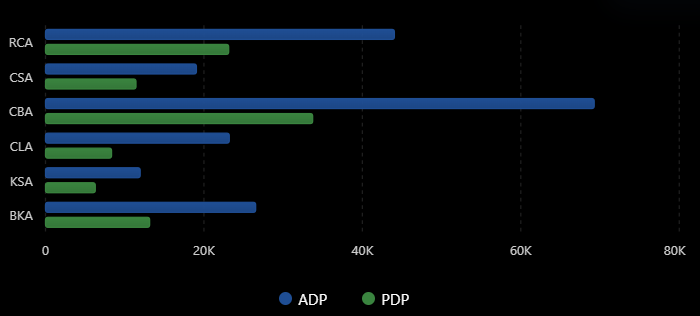
Post-synthesis characterization, Sky130HD
| Topology | Area | Crit. path | Fmax | Power | ADP | PDP |
|---|---|---|---|---|---|---|
| Ripple-Carry (RCA) | 1,761.7 µm² | 25.00 ns | ~40 MHz | 925 µW | 44,042 | 23,125 |
| Carry-Select (CSA) | 2,635.0 µm² | 7.23 ns | ~138.3 MHz | 1,580 µW | 19,051 | 11,423 |
| Carry-Bypass (CBA) | 2,875.3 µm² | 24.09 ns | ~41.5 MHz | 1,400 µW | 69,265 | 33,726 |
| Carry-Lookahead (CLA) | 7,204.4 µm² | 3.22 ns | ~310.6 MHz | 2,590 µW | 23,198 | 8,340 |
| Kogge-Stone (KSA) | 3,080.5 µm² | 3.88 ns | ~257.7 MHz | 1,620 µW | 11,952 | 6,286 |
| Brent-Kung (BKA) | 2,058.2 µm² | 12.89 ns | ~77.6 MHz | 1,020 µW | 26,531 | 13,148 |
Relative to Ripple-Carry, Sky130HD
| Topology | Area | Fmax | Power | ADP | PDP |
|---|---|---|---|---|---|
| Carry-Select | 1.50× | 3.46× | 1.71× | 0.43× | 0.49× |
| Carry-Bypass | 1.63× | 1.04× | 1.51× | 1.57× | 1.46× |
| Carry-Lookahead | 4.09× | 7.77× | 2.80× | 0.53× | 0.36× |
| Kogge-Stone | 1.75× | 6.44× | 1.75× | 0.27× | 0.27× |
| Brent-Kung | 1.17× | 1.94× | 1.10× | 0.60× | 0.57× |
Block-width study
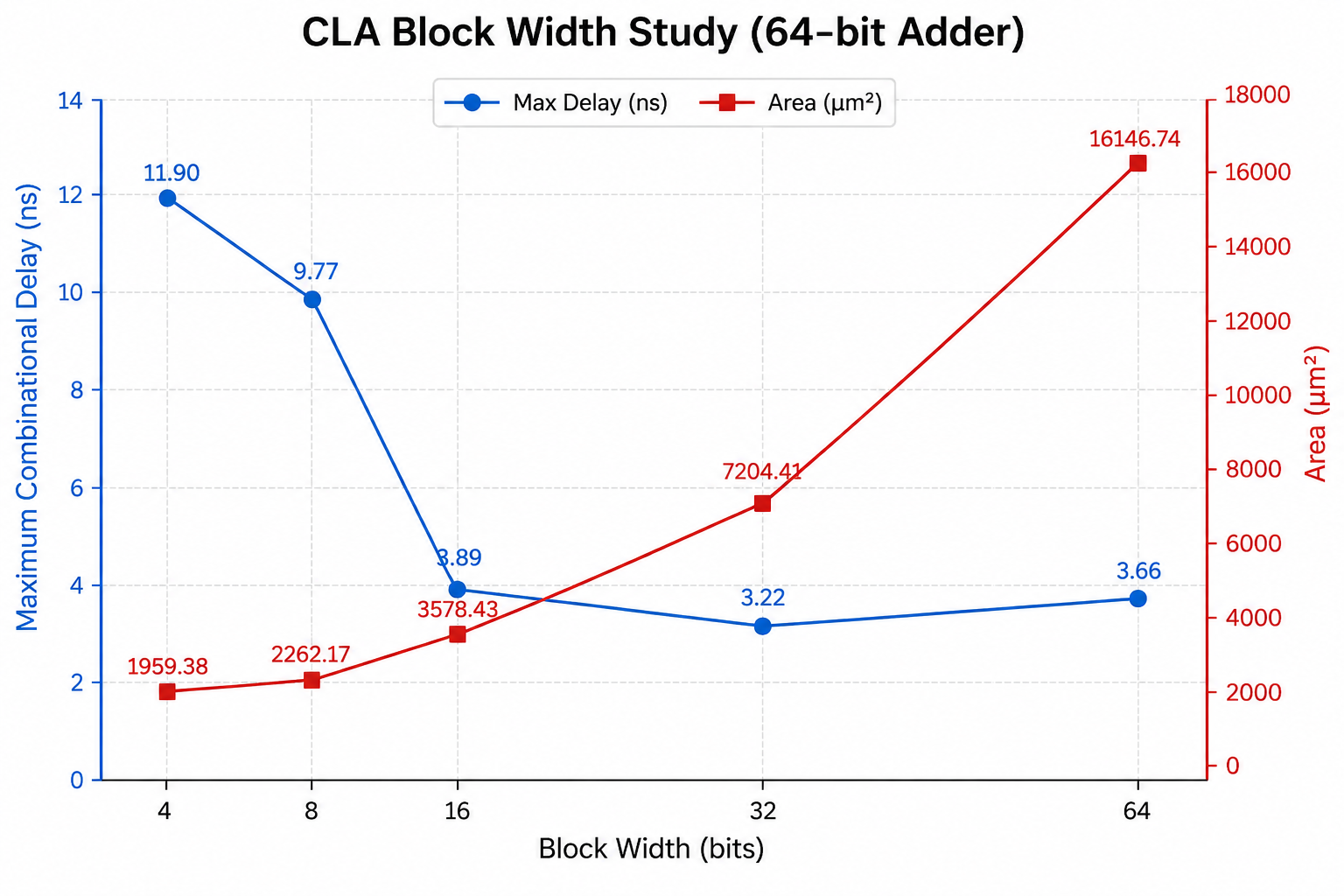
For block-structured topologies (CLA, CSA, CBA), block width is a free parameter: wider blocks reduce the number of stages the carry has to ripple through but grow the logic inside each block. Sweeping this parameter on the Nangate45 library shows the trade-off directly.
Cross-library comparison, Nangate45
| Topology | Area | Crit. path | Fmax | Power |
|---|---|---|---|---|
| RCA | 391.6 µm² | 2.10 ns | ~476.2 MHz | 246 µW |
| CSA | 519.8 µm² | 1.11 ns | ~900.9 MHz | 446 µW |
| CBA | 551.2 µm² | 2.90 ns | ~344.8 MHz | 330 µW |
| CLA | 1,441.2 µm² | 0.85 ns | ~1,176.5 MHz | 729 µW |
| KSA | 653.3 µm² | 0.95 ns | ~1,052.6 MHz | 462 µW |
| BKA | 416.6 µm² | 1.83 ns | ~546.4 MHz | 285 µW |